

How much does Shopify cost? Pricing breakdown showing Shopify Basic, Shopify, and Advanced plans with monthly ecommerce pricing and features.
How Much Does Shopify Cost?
If you are comparing ecommerce platforms or planning your first online store, the question usually starts here: how much does Shopify cost, and how much is Shopify a month for a real business? The short answer is that Shopify can be very affordable to start, but the real total depends on your plan, payment setup, apps, theme choice, and how much support you need after launch.
For most businesses, Shopify costs anywhere from around $39/month to several hundred dollars per month, depending on the plan, apps, payment setup, and overall store complexity. A lean store may run on a relatively small monthly budget, while a faster-growing brand can spend much more once app subscriptions, payment processing, email tools, POS add-ons, and marketing enter the picture. That is why a proper Shopify cost breakdown matters more than just quoting the base plan price. As stores scale, Shopify speed optimization becomes important for maintaining fast loading times and a better user experience.
Quick Answer: How Much Does Shopify Cost Per Month?
If you are wondering how much Shopify costs a month, the answer depends on your plan, apps, transaction fees, and overall business needs. If you only need a basic online store, your total monthly cost can stay relatively low. If you need advanced reports, better transaction economics, POS features, extra apps, or enterprise tools, the monthly total rises quickly. Shopify’s official pricing page also notes that select plans offer annual billing discounts of up to 25%, and that pricing can vary by region and billing setup.
Shopify Cost Per Month by Plan
Below is the cleanest way to think about Shopify pricing plans in 2026. The exact display price can vary by country, currency, tax, and whether you pay monthly or annually, but the structure remains the same. In current US-focused pricing summaries, the standard plans are commonly referenced as Basic $39/month, Grow $105/month, Advanced $399/month, and Shopify Plus from $2,300+/month, while Shopify’s official pricing page also highlights annual discounts on select plans.
| Shopify Plan | Typical Monthly Price | Best For |
| Starter | Low-cost entry plan | Selling through links and social channels |
| Basic | ~$39/month | New stores and small businesses |
| Grow | ~$105/month | Brands with growing order volume |
| Advanced | ~$399/month | High-volume stores needing deeper reporting |
| Shopify Plus | $2,300+/month | Enterprise and large-scale ecommerce |
Prices vary by country, taxes, promotions, and billing terms. Always confirm the latest figures on Shopify’s official pricing page.
What Most Store Owners Actually Pay Each Month
The reason so many people search for “how much does Shopify cost per month” is because the advertised plan fee rarely tells the whole story. A real store might also pay for a premium theme, review app, email platform, subscription tool, upsell app, reporting add-ons, or extra retail features. Competitor pricing breakdowns consistently show that the true monthly operating cost is often higher than the base plan alone, especially once a store begins scaling.
For a practical benchmark, a small business store may spend around $39 to $150 per month when you combine the base subscription, a few essential tools, and a domain. A more mature store with stronger retention and sales tools can spend several hundred dollars monthly before paid advertising is even included. Many growing brands invest in Shopify app development to build custom features and improve store functionality.
Shopify Pricing Plans Explained (2026 Comparison)
If you want Shopify pricing explained clearly, the easiest approach is to match each plan to the stage of business it was built for. Shopify’s pricing page positions its standard plans around merchant growth, with increasing access to reporting, staff accounts, and improved payment economics as you move up the ladder.
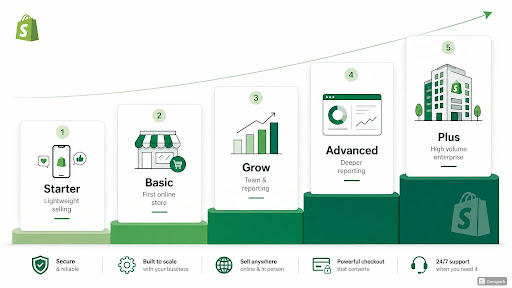
Shopify pricing plans comparison showing Starter, Basic, Grow, Advanced, and Shopify Plus plans for different ecommerce business stages and growth needs.
Shopify Starter Plan
The Starter plan is best viewed as a lightweight selling option rather than a full ecommerce website. It suits creators, small social sellers, or anyone testing product demand before investing in a complete storefront. If your goal is to sell through social channels, a link-in-bio workflow, or a simple checkout path, this plan can be enough at the beginning. But it is not the right choice if you want a robust content-led store with collections, blogs, SEO landing pages, and deeper customization. Professional Shopify store setup services help businesses launch stores with the right structure, settings, and user experience.
Shopify Basic Plan
The Basic plan is where most first-time merchants start. It gives you a proper online store, core sales tools, Shopify Payments access, blog functionality, and the essential infrastructure that makes Shopify attractive to small businesses. If someone asks how much Shopify costs for small businesses, Basic is usually the most relevant answer because it balances affordability with enough functionality to run a serious store. Competitor content also positions Basic as the natural starting point for smaller brands.
Shopify Grow Plan
Grow is designed for brands that have already found traction and need more operational control. It is the plan you consider when reporting, team access, and incremental fee savings begin to matter. RigbyJS and 20North both frame this mid-tier plan as the stage where Shopify starts supporting more complex store operations beyond the lean startup phase. As stores grow, many brands migrate from WordPress to Shopify for easier management and better scalability.
Shopify Advanced Plan
Advanced is for stores that care about deeper reporting, more staff support, and better transaction efficiency at higher sales volumes. If your business is processing significant monthly revenue, this plan can become more economical than it looks because lower payment-related costs can offset some of the higher fixed fee. Shopify also highlights advanced reporting and stronger operational capability at this tier.
Shopify Plus Pricing: How Much Does Shopify Plus Cost Per Month?
Shopify Plus pricing deserves its own section because it behaves differently from the standard plans. People searching for Shopify Plus cost per month usually are not just comparing a software fee. They are evaluating whether their business has reached the scale where enterprise features justify a much larger investment.
What Is Included in Shopify Plus
Shopify’s official pricing page positions Shopify Plus as the enterprise tier for high-growth and large-scale commerce. It includes capabilities such as advanced checkout customizations, higher API limits, expanded stores, B2B support, better support access, and enterprise-grade operational controls. That makes it much more than a simple plan upgrade. It is designed for brands that need greater scale, control, and infrastructure flexibility.
Shopify Plus Cost Per Month
In widely referenced current pricing summaries, Shopify Plus starts at $2,300+ per month , although the final price can depend on contract structure, term length, business profile, and region. Shopify’s own pricing page also indicates Plus pricing can be contract-based and varies depending on term, rather than functioning like a flat standard monthly plan.
Who Should Choose Shopify Plus
Shopify Plus is usually the right fit for enterprise brands, multi-market sellers, complex B2B operations, or stores that need advanced custom workflows and very high checkout reliability. If your store is still early-stage, Plus is almost always too much. But if your brand is processing high revenue, running multiple storefronts, or demanding heavy operational automation, the value can be real. This is why a standard answer to how much does Shopify cost is incomplete unless it separates normal plans from Shopify Plus clearly.
Shopify Monthly Cost Breakdown: What You Actually Pay
To understand Shopify’s monthly cost, you need to break the number into layers. Most merchants pay a mix of fixed software costs and variable transaction-related costs, which means your total monthly spend changes with your plan, sales volume, and tech stack.
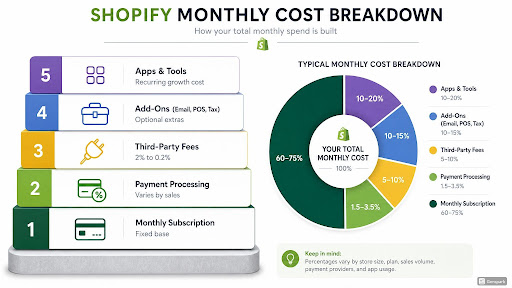
Shopify monthly cost breakdown infographic showing subscription fees, payment processing, third-party transaction fees, apps, tools, and Shopify add-on costs.
Monthly Subscription Fee
The first layer is the plan itself. This is the most visible cost and the easiest to budget. If you stay on Basic, your fixed software spend remains relatively predictable. If you upgrade to Grow or Advanced, your fixed cost goes up, but you gain better features and potentially better fee structures. Annual billing can reduce the monthly equivalent on select plans, which is worth considering if you know you will stay on Shopify long term.
Payment Processing Fees
Payment processing is one of the most important parts of any Shopify cost calculation. Shopify’s official pricing tables show that card rates vary by plan, with better rates available as you move to higher tiers. This is one reason merchants with rising volume eventually reconsider whether they are on the right plan: even modest changes in payment rates can materially affect margin at scale.
Third-Party Transaction Fees
If you use Shopify Payments, you avoid Shopify’s extra third-party transaction fee. If you choose another gateway, Shopify adds a platform fee on top of whatever your gateway already charges. In current pricing examples on Shopify’s official page, that extra fee can range from 2% on Basic down to 0.2% on Plus , depending on plan tier. That is a major reason why merchants often stick with Shopify Payments when it is available in their region.
Shopify Email, POS, Tax, and Other Add-Ons
Shopify’s official pricing page also makes it clear that the ecosystem includes optional extras like Shopify Email, POS Pro, Tax services, and Marketplace Connect. For example, Shopify notes the first 10,000 Shopify Email emails per month are free, while POS Pro is priced separately per location on standard plans. Those add-ons are not always required, but they can significantly increase what you actually pay if your business relies on them.
| Monthly Cost Layer | Typical Impact on Budget |
| Plan subscription | Fixed monthly base |
| Payment processing | Variable, based on sales volume |
| Third-party transaction fees | Extra cost if not using Shopify Payments |
| POS / Email / Tax add-ons | Optional but can add meaningful monthly expense |
| Apps and external tools | Often the fastest-growing recurring cost |
Shopify Cost Breakdown: Hidden Costs Beyond the Monthly Plan
This is the part many merchants underestimate. A good Shopify cost breakdown should cover the expenses that sit outside the obvious plan fee. Those “small” costs are often what turn an affordable store into a noticeably more expensive one over time. Both ranking competitor articles emphasize these hidden costs, especially apps, domains, themes, and add-ons.
Shopify Theme Costs
Shopify includes free themes, which is great for lean launches. But many merchants eventually upgrade to a premium theme for stronger design, conversion-focused layouts, and better merchandising flexibility. Competitor breakdowns commonly place premium theme costs in the $150 to $400 one-time range. That cost is not monthly, but it is real, and it often arrives early in the store-building process. Many brands invest in Shopify theme development to create a more customized and conversion-focused storefront.
Custom Domain Costs
A branded domain is another expense that looks small but should still be part of your planning. Typical standard domains are often cited at around $14 to $20 per year. That is not a huge number, but it matters because nearly every serious store will need one. A free subdomain may be technically possible, but it is rarely the right long-term branding choice.
Shopify App Costs
App spending is where many stores lose control of their budget. Review apps, subscription tools, bundle builders, upsell software, loyalty platforms, analytics tools, and email integrations all sound useful, and many of them are. But when each app adds another monthly fee, your stack can become surprisingly expensive. Both competitor articles call out apps as one of the most common cost surprises for merchants.
Developer and Custom Setup Costs
Not every Shopify store needs custom development, but some absolutely do. If you need ERP integration, custom product logic, a tailored customer experience, headless elements, or advanced subscription behavior, developer cost becomes part of your total Shopify investment. 20North specifically notes that integration and custom development costs vary widely depending on complexity. That range can move from minor setup support into substantial project budgets very quickly.
Marketing and Advertising Costs
Even though this is not a Shopify software fee, it is still part of what many merchants mean when they ask how much a Shopify store costs. Launching the store is only step one. If you need paid ads, email flows, SEO content, UGC, or influencer seeding to drive sales, your true ecommerce operating cost rises far beyond the plan fee. This is also why some stores feel “cheap” to build but expensive to grow.
How Much Does It Cost to Run a Shopify Store?
If you ask how much it costs to run a Shopify store, the most accurate answer is: it depends on the business stage. A lean store, a growth-stage DTC brand, and an enterprise merchant do not operate with the same cost structure.
Shopify Cost for Small Business
For a small business, Shopify is often relatively manageable. A Basic plan, a custom domain, and a few key tools may keep your software spend in a modest range, especially if you avoid app overload. Competitor estimates suggest many smaller stores fall into a range of roughly $39 to $150 per month when combining subscription, a few apps, and a domain, not including broader marketing spend.
Cost to Run a Growing Shopify Store
A growing store usually spends more because it starts using more of the ecosystem. At this stage, merchants often move to Grow or Advanced, pay more attention to transaction economics, and invest in extra software for retention, conversion, and analytics. This is where the question changes from “how much does Shopify cost?” to “what does it cost to run Shopify well?”
Cost to Run a High-Volume or Shopify Plus Store
At high scale, fixed software cost becomes less important than operational efficiency. Payment rates, custom integrations, POS expansion, staff access, checkout reliability, and enterprise tooling begin to matter far more. Shopify Plus merchants often care less about the headline monthly number and more about the total cost of ownership relative to complexity, revenue scale, and internal team needs. RigbyJS highlights this exact point in its cost analysis of scaling stores.
| Store Stage | Typical Cost Mindset |
| Small business | Keep fixed monthly costs low, use only essential tools |
| Growing brand | Balance plan upgrades with fee savings and software needs |
| High-volume / Plus | Optimize for scale, automation, and margin protection |
Shopify Plan Comparison: Which Plan Is Best?
A strong Shopify plan comparison is not really about choosing the cheapest tier. It is about matching the plan to what your business actually needs now, without overpaying too early. The best Shopify plan depends on your business stage, monthly sales volume, reporting needs, and operational complexity.
Best Shopify Plan for Beginners
For most beginners, Basic is the best place to start. It offers a real ecommerce foundation without overwhelming cost. Unless you are only selling through a lightweight social-first workflow, Basic usually delivers the clearest value-to-price ratio for a new store.
Best Shopify Plan for Growing Brands
For growing brands, Grow often becomes the most balanced option. It is expensive enough to feel like a real upgrade, but still accessible compared with Advanced or Plus. If your store has enough order volume for reporting improvements and better operational structure to matter, Grow can make sense.
Best Shopify Plan for High-Volume Businesses
For high-volume stores, Advanced is often the strongest standard plan before enterprise. It gives you deeper reporting and stronger payment economics. Shopify Plus becomes the right move only when complexity, growth, or scale genuinely require enterprise functionality rather than when a brand simply wants a bigger plan for status.
Frequently Asked Questions About Shopify Cost
1. How much does Shopify cost for small businesses?
For most small businesses, Shopify starts with the Basic plan and can remain relatively affordable if you keep the app stack lean. A realistic small-business monthly budget often includes the base plan, a domain, and a few essential tools, rather than the plan fee alone.
2. How much does Shopify cost per month?
Shopify’s cost per month depends on the plan you choose and the extra tools you use. Standard US-referenced plan pricing is commonly cited as around $39/month for Basic, $105/month for Grow, $399/month for Advanced, and $2,300+/month for Shopify Plus, with region and billing differences on the official pricing page.
3. How much does Shopify cost a month for beginners?
For beginners, the most relevant answer is usually the Basic plan plus a small set of essentials. If you stay disciplined on apps and use Shopify Payments, the monthly cost can remain manageable in the early stage.
4. How much does a Shopify store cost to run?
The cost to run a Shopify store depends on the stage of the business. Small stores may spend modestly, while growing or enterprise stores can spend far more once payment costs, apps, POS, email tools, and development needs are added.
5. What is Shopify Plus pricing?
Shopify Plus pricing typically starts at $2,300+ per month in current public summaries, but the exact number can depend on contract terms, region, and enterprise needs. Shopify’s official pricing page also signals that Plus is structured differently from standard monthly plans.
6. Does Shopify charge transaction fees?
Yes, Shopify can charge additional transaction fees if you use a third-party payment provider instead of Shopify Payments. On Shopify’s official pricing tables, those added fees vary by plan tier and decrease as plans become more advanced.
7. What is the cheapest Shopify plan?
The cheapest Shopify option is the lightweight Starter-tier entry path, but for most businesses wanting a real online store, Basic is the first serious ecommerce plan worth considering.
Final Thoughts on Shopify Pricing
If you want the most honest answer to how much Shopify costs, here it is: Shopify is not expensive to start, but it can become significantly more expensive as your business becomes more capable. That is not necessarily a bad thing. In many cases, rising costs reflect rising revenue, better infrastructure, and more advanced operational needs.
The smart way to budget is to look beyond the headline plan fee. Consider your plan, your payment setup, your app stack, your email and POS needs, your theme choice, and your growth strategy together. When you do that, your Shopify monthly cost becomes much easier to forecast, and your decision-making becomes much stronger. For most stores, Shopify monthly costs start relatively low but increase as your business scales and requires more tools and automation.